Practical guide
Why a Flag Emoji Shows Letters Instead of a Flag
A regional flag emoji can contain two Regional Indicator characters that look like letters when a flag glyph is unavailable. They differ from ordinary typed country-code letters. Unicode describes letter-like and missing-flag fallback options, but a screenshot alone does not identify the stored text or diagnose a device. Preserve the sample, compare its code points and write the region name when the message depends on it.
Distinguish the picture from the stored text
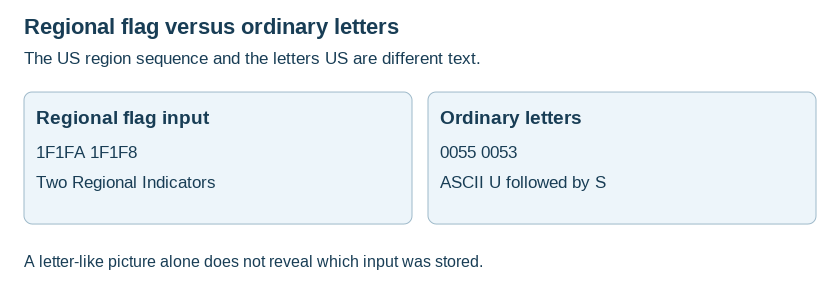
“I see US” can describe ordinary letters, two letter-like Regional Indicators, a picture containing letters, or someone’s description of a flag. Start with the actual text sample. If only a screenshot is available, keep the input question unresolved until you obtain that small sample.
Unicode defines an emoji flag sequence as two Regional Indicator characters. The pair represents a region. It does not prescribe one exact flag artwork, guarantee that a receiving system has the glyph, or establish what a sender meant by using it. [1]
Compare Regional Indicators with ordinary letters
On a narrow screen, scroll this table sideways. Keyboard readers can focus the table region and use the arrow keys.
| Input | Code points | What the input establishes |
|---|---|---|
🇺🇸 | 1F1FA 1F1F8 | Listed United States region sequence; not ordinary U and S. |
US | 0055 0053 | Ordinary ASCII letters; a different input from the regional flag. |
🇬🇧 | 1F1EC 1F1E7 | Listed United Kingdom region sequence, using GB. |
🇪🇺 | 1F1EA 1F1FA | Listed European Union sequence. |
🇺🇳 | 1F1FA 1F1F3 | Listed United Nations sequence. |
🚩 | 1F6A9 | Single triangular-flag character; not a two-indicator sequence. |
The four regional inputs match actually read rows in both the captured sequence data and keyboard/display data. The ordinary US row is a constructed comparison. The triangular flag has its own code point and listed name. The samples are live text: their appearance here may vary, while the hex values remain the comparison. [2][3]
Understand the fallback explanation
For a Regional Indicator pair without a specific flag or other glyph, Unicode gives two presentation options: show the indicators separately as letters in dotted squares, or use the same missing-flag glyph for unsupported pairs. This explains why letter-like shapes can accompany intact flag text. It does not say that every platform uses those exact shapes. [1]
Do not conclude “the sender typed US” from appearance alone. Nor does an intact pair prove support on the receiving device. Keep the input, the observed drawing and the environment separate. Unavailable glyph support is a possible explanation; this guide has not established the cause on your device.
Not every flag uses a regional pair
The rainbow and pirate flags use ZWJ sequences, covered in the joined-emoji guide. The red triangular flag is a single character. A flag-like picture is therefore not enough to choose the encoding rule.
Annex B cautions that regional pairs represent regions rather than a specific immutable flag. Some represent countries; others territories. Platforms may depict a territory differently, and artwork can change as flags and software change. Validity is tied to documented region data, with EU and UN the valid macroregion exceptions. Arbitrary two-letter abbreviations are not a recipe for creating flags. [1]
If your question concerns a symbol’s cultural or political meaning, it needs sources for that context. Character encoding alone cannot establish a sender’s location, identity or view. This page answers display confusion.
Compare the sample without changing the evidence
- Keep the original small text sample and note its observed appearance.
- Identify whether it contains Regional Indicators, ordinary letters, a single flag character or a joined sequence.
- For the four regional examples here, compare the exact table values. For a different sequence, consult current official data rather than extrapolating from a nickname.
- If copying changes the code points, label the copy as a different input. That is not a display-only result.
- If the same input draws differently elsewhere, record the actual app, document or browser and its known version. That observation does not prove a universal support rule.
- For your own new message, use an available emoji picker if appropriate. Keep the new selection distinct from the preserved original.
When travel, a meeting or a document depends on the region, write its name beside the icon. “United Kingdom office” remains understandable if a flag renders as letters. Do not leave the flag as the only instruction or infer someone’s location from a symbol they may have personalized.
Try three original flag checks
These are constructed comparisons, not observed device behavior.
Case 1
A screenshot looks like US. Does that prove its text is 0055 0053?
Show answer and explanation for case 1
No. Obtain the original text sample.
Two Regional Indicators and ordinary ASCII letters are different stored inputs. A letter-like fallback could resemble letters; the screenshot alone does not decide the code points.
Case 2
The saved text is 1F1EC 1F1E7. Should it be changed to ordinary UK to repair its encoding?
Show answer and explanation for case 2
No. The captured official data lists the GB Regional Indicator pair for United Kingdom.
Typing UK creates a different string. A written region name can clarify the message without pretending to preserve the original flag encoding.
Case 3
A regional flag is listed in Unicode data. Does that prove every app displays one identical official flag?
Show answer and explanation for case 3
No. Listing, rendering support and artwork are different facts.
Annex B gives fallback options and describes region-versus-flag and platform differences. Use actual evidence for a named app instead of turning a data listing into a device test.
Keep the region and original sample visible
Download the exact Unicode display samples. The plain-text file keeps literal inputs beside their expected code points. The deliberately spaced and ordinary-letter comparisons are labelled. It supplies inputs to compare, not results from a tested phone.
Use the heart-presentation comparison for a style selector, or the skin-tone modifier comparison for a hand beside a swatch. If the flag is a cue in a conversation, return to the actual words. Its code points do not supply an unstated interpersonal meaning.
Sources and further reading
- Unicode Emoji 18.0, revision 31: valid flags and fallbackAnnex B: region sequences, validity, EU/UN exceptions and letter-like or missing-flag presentation.
- Unicode 18.0 emoji sequence dataSelected actual US, GB, EU and UN rows with the RGI_Emoji_Flag_Sequence type.
- Unicode 18.0 keyboard/display test dataSelected regional-flag and triangular-flag rows. A data listing is not a tested app matrix.