Practical guide
One Acronym, Several Meanings: A Context-Checking Guide
Read the exact sentence before choosing an expansion. PM can describe a time, a private message or a role; DM can belong to messaging, measurement or an old currency record. Compare the grammar and domain, then separate the meaning from the person or action still to identify. Original examples, eight explained cases and a context worksheet help you ask for the detail that matters.
Separate the expansion, the reference and the action
A dictionary can tell you that PM has several recorded uses. A particular message still needs its own reading. “Our PM changed it” leaves at least three questions: what PM stands for, which person or thing the writer means, and what changed. Solving the first question does not automatically solve the other two.
- Expansion: which full phrase fits these letters in this sentence?
- Reference: which person, message, time, project or document does that phrase point to?
- Action: what, if anything, are you being asked to do?
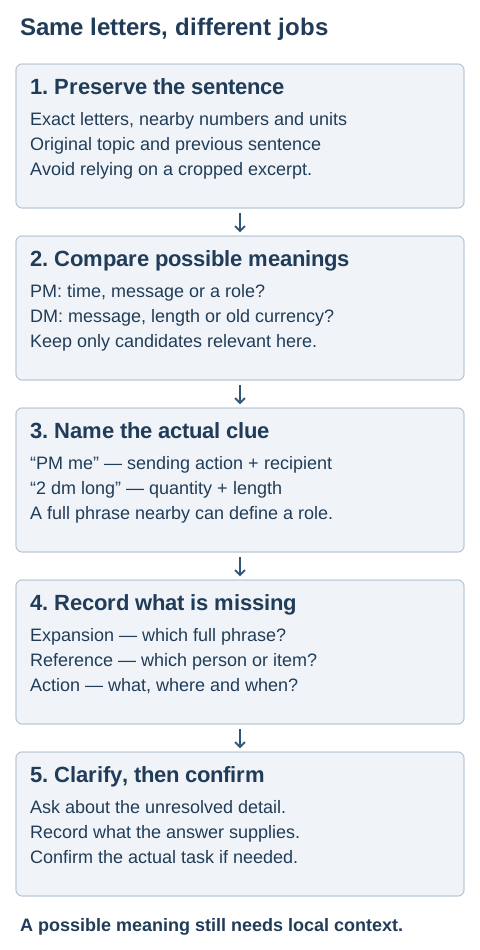
Start by preserving the exact words, including a nearby number or unit. Read the previous sentence and the discussion topic before choosing an expansion. When the message asks for an action, identify the item, recipient and timing separately. Those details are more useful than a long list of definitions unrelated to the task.
PM, p.m., DM and dm are short forms with several possible readings. The worked messages are original illustrations, with context supplied so you can compare the candidates. Use the same process on your own message, keeping the actual words and missing details visible.
PM: compare time, messages and two roles
Cambridge’s PM entry records several different jobs for the same letters. The time notation p.m. describes afternoon, evening or night. PM can be an informal noun for a private message, and a verb for sending one. The entry also records UK informal prime minister and informal business project manager.
| Recorded use | What the sentence needs | Original example | Remaining question |
|---|---|---|---|
| p.m. — time | Afternoon, evening or night; the time notation follows a clock value. | “The pickup is at 4 p.m.” | Which date and time zone apply, if needed? |
| PM — private message, noun | A message rather than a public reply. | “I sent you a PM about the address.” | Which conversation and platform? |
| PM — private message, verb | Send someone a private message. | “PM me the meeting point.” | Who receives it, where and what details? |
| PM — prime minister | UK informal use for a political office-holder. | “The PM answered questions after the cabinet meeting.” | Which country, person and date? |
| PM — project manager | Informal business use for a project role. | “Our PM updated the delivery schedule.” | Which project, named person and authority? |
The examples deliberately add useful words: a clock value, a recipient, a cabinet meeting or a delivery schedule. These narrow the candidate set. A label such as “work chat” is broader: a work chat may discuss a project manager, an evening meeting or sending a message. The platform alone does not settle the sentence.
The dictionary’s usage labels describe the recorded entry. They do not mean every British speaker uses PM in the same way, or that every business has the same role title. In a workplace with its own glossary, look for an explicit local definition or ask the writer to name the person.
Use sentence clues before a familiar default
Compare these two messages: “PM me the room number” and “The PM confirmed the room number.” In the first, PM functions as a verb with “me” as the recipient. Private-message usage fits that construction. In the second, “the PM” is a noun phrase referring to someone or something. Both prime minister and project manager could fit the grammar; the topic is needed to distinguish them.
A clock number changes the comparison: “The room opens at 4 PM.” The time phrase is the useful reading. Knowing it refers to the afternoon still does not identify the date or venue. If you are coordinating across places, check the relevant time zone in the actual invitation.
A preceding full phrase is especially useful. In “Our project manager, Rina, approved the draft. The PM will send it tomorrow,” the local wording supplies project manager. Preserve that sentence when quoting the message. The abbreviation can be clear even while “it” or “tomorrow” becomes unclear in an isolated screenshot.
Capitalization and punctuation are supporting clues, rather than a substitute for reading the sentence. Keep PM, p.m., DM or dm as written when recording an example. A casual writer may use different formatting; an unclear unit or document label deserves checking at the source. Do not silently correct a measurement into a chat term.
DM: the domain can change the candidate meaning
DM provides a second comparison across three domains. Cambridge records direct message as a social-media noun and verb. Its linked decimetre entry records dm as a length abbreviation, equal to 0.1 metre. Its Deutschmark entry records DM for the German money unit used before the euro.
| Short form and candidate | Useful surrounding domain | Original message | What to verify |
|---|---|---|---|
| DM — direct message | Social-media or messaging conversation | “DM me the meeting point.” | Which recipient and platform are intended? |
| dm — decimetre | A length measurement; 1 dm = 0.1 m | “The sample is 2 dm long.” | Confirm the unit in the original measurement. Here 2 dm = 0.2 m. |
| DM — Deutschmark | A historical German money amount | “The archived receipt lists 50 DM.” | Identify the document and currency; do not read an old amount as today’s price. |
“DM me” and “2 dm long” do different grammatical jobs as well as belonging to different domains. A bare “DM” in a cropped image leaves those clues missing. The first example has a sending action and recipient. The second has a quantity and length description. The old receipt has a money amount and a historical document context.
This is a small documented candidate set, not a claim that these are every expansion in every specialist community. If none fits, look for the relevant glossary or ask for the intended phrase. Adding more unrelated definitions can make a short message harder to understand without resolving its real uncertainty.
Keep a plausible meaning separate from a confirmed meaning
Suppose an isolated note reads “The PM will review it.” The words support a role noun, but they do not identify the role or the item. If the surrounding thread discusses a building project, project manager is plausible. If it discusses a cabinet announcement, prime minister is plausible. A cropped excerpt may omit exactly the evidence needed to choose.
Write down both the candidate and the clue: “Project manager is plausible because the thread concerns the delivery schedule.” Then record what is still missing: “No person or project is named in this excerpt.” This is more useful than saying “I am 90% sure” without a measured basis for that number.
Look for a named person, an earlier full phrase, a glossary linked by the group, or the original document. When those sources conflict, ask a specific question rather than treating the first result you found as decisive. The writer can explain their own local use; a reference source can explain a published document’s terminology.
Also distinguish literal meaning from mood. Recognizing “private message” does not tell you whether the sender is friendly, annoyed or romantic. It does not establish how a particular platform stores or shares messages. If the practical issue is where to send something, confirm the actual platform and recipient instead of reading those details into the abbreviation.
Ask for the unresolved detail, then confirm the task
A useful question follows the uncertainty you actually have. If the expansion is missing, try “What does PM stand for in this note?” If the role is known but the person is not, try “Which project manager do you mean?” If you know the person but not the requested action, ask “Which draft should I send, and where?”
When two candidate meanings remain, name the real alternatives: “By PM, do you mean a message or the project manager?” Keep that pair tied to the sentence. Do not offer time or political-office alternatives if the original words have already ruled them out.
After the answer, restate the practical instruction when it matters: “Thanks—so I should send the revised room plan to Rina in the project chat today?” Use only details the exchange actually supplied. An answer that spells out project manager may still leave the project, file or recipient unidentified.
For an optional joke or caption, you can leave the reference unexplained. A real deadline, measurement or document interpretation may need a direct check. Use invented or anonymized messages for group practice, keeping private names and conversation details out of a shared worksheet. For more situations and phrasing options, use the separate acronym clarification reply guide.
Practice eight expansion, reference and action decisions
Read each fictional message and decide which clues it supplies. Explain what remains unresolved before opening the answer. The exercise tests the particular sentence and stated context, rather than a person’s ability to guess a sender’s private intention.
Case 1
The message says “Meet at 4 PM” but gives no date or place. Does recognizing the time notation finish the planning task?
Show answer and explanation for case 1
No. It identifies a time of day, while the missing arrangements still need checking.
The clock number and “at” support the time reading. They do not supply the date, location or relevant time zone. Ask for the specific missing details when they affect arrival. Do not turn a correct expansion into an assumption that the whole instruction is complete.
Case 2
Someone writes “PM me the draft.” You found “project manager” in a dictionary. Should you expand the sentence as “project manager me the draft”?
Show answer and explanation for case 2
The private-message verb fits this sentence; the project-role noun does not fit that ordinary construction.
“Me” is the recipient and “the draft” is what the writer asks you to send. The surrounding words make the private-message verb the useful candidate. Confirm the platform and intended recipient if those are not already clear. Syntax supports the reading without proving that sending a particular file is appropriate.
Case 3
A clipped screenshot says “The PM will review it.” Is choosing prime minister or project manager from those five words alone reliable?
Show answer and explanation for case 3
Keep the role unresolved and obtain the original topic or a named person.
Both are nouns that fit after “the” and before “will review.” A government discussion may support one candidate; a project discussion may support another. The article and verb do not decide between them. Ask “Which PM and what item are you referring to?” if the answer matters.
Case 4
The original note says “Our project manager, Rina, approved the draft. The PM will send it tomorrow.” What provides the strongest local expansion clue?
Show answer and explanation for case 4
The full phrase in the preceding sentence: project manager.
The nearby explicit phrase supplies a concrete local meaning for the abbreviation. Preserve that context when quoting the note. It still leaves separate questions about what “it” refers to and which date “tomorrow” means if the note is copied later. An expansion and a current instruction need separate checks.
Case 5
In a measurement exercise, “2 dm long” appears beside a length diagram. Does DM’s messaging definition fit, and what is the length in metres?
Show answer and explanation for case 5
The measurement reading fits: two decimetres equal 0.2 metres.
Cambridge records dm as the abbreviation for decimetre and gives one decimetre as 0.1 metre. Multiply 2 by 0.1 to obtain 0.2. The number, “long” and diagram supply length context. Keep the original unit spelling and check unclear copies rather than substituting a chat definition.
Case 6
A historical German receipt contains “50 DM.” Should a social-media DM definition be used to interpret the amount?
Show answer and explanation for case 6
The historical-currency candidate fits that context: Deutschmark.
Cambridge identifies DM as its abbreviation and describes it as the German money unit used before the euro. The receipt context supplies a currency amount, not an instruction to send fifty messages. Identifying the currency does not calculate a present-day price or an exchange rate; those would require other evidence.
Case 7
A colleague says “PM means project manager here,” but you still do not know which of two projects needs your file. Should you keep asking for the expansion?
Show answer and explanation for case 7
Ask for the project, file and intended recipient that remain unidentified.
The lexical meaning has been clarified. The unresolved part is the reference and action. A useful follow-up is “Which project and file should I send, and to whom?” It targets the actual decision instead of repeating an already answered dictionary question.
Case 8
A cropped caption says “PM?” with no surrounding words. Can its punctuation alone establish a particular expansion or the sender’s intention?
Show answer and explanation for case 8
No. Ask for the surrounding message or the intended full phrase if you need to respond.
A question mark indicates a question-like presentation, but it does not name the missing domain, referent or requested action. Several candidates remain possible. You can leave an optional caption unexplained. If a real plan depends on it, request the information that lets you act instead of assigning a confidence percentage to a guess.
Use a context record before replying
Download the editable acronym context record and explained exercises (TXT). It includes blank comparison rows, the PM and DM examples, all eight questions and their explanations. You can fill it in on paper or locally without submitting a chat to this site.
Exact short form and surrounding sentence:
Original discussion or document context:
Small candidate set and relevant source:
Specific clue supporting each candidate:
What would conflict with that reading?
Unresolved expansion, reference or action:
One targeted question, if the answer matters:
Confirmed meaning and practical instruction:
What changed after the clarification?
Keep the distinction visible when you revise the record. Replace an unsupported candidate after receiving better information, and note what supplied the answer. If the expansion stays the same but the intended person or action changes, update that separate field rather than pretending the dictionary entry was wrong.
For broad browsing, return to the acronym directory. If you understand the letters but are missing a shared story, the IYKYK meaning guide and its inside-joke comparison address that different problem. The next useful step is the one that supplies the information your actual message lacks.
Sources and further reading
- Cambridge Dictionary: PM / p.m.Time notation, private-message noun and verb, UK informal prime minister and informal business project manager. These establish possible uses, not the meaning of every message.
- Cambridge Dictionary: DMDirect-message noun and verb, with links to the measurement and historical-currency entries.
- Cambridge Dictionary: decimetreThe dm abbreviation and the length of one decimetre: 0.1 metre.
- Cambridge Dictionary: DeutschmarkDM as the abbreviation for the German money unit used before the euro.