Practical guide
Gen, Genq and Srs Tone Indicators: Differences and Examples
/gen commonly labels genuine intention, /genq a genuine question and /srs serious intention. They overlap: a question can be both genuine and serious. Read the actual words, keep each cue with the part it labels, and write out the meaning when your reader does not know the convention. These original dialogues and correction exercises show what the tags can explain and what they leave unresolved.
What do /gen, /genq and /srs mean?
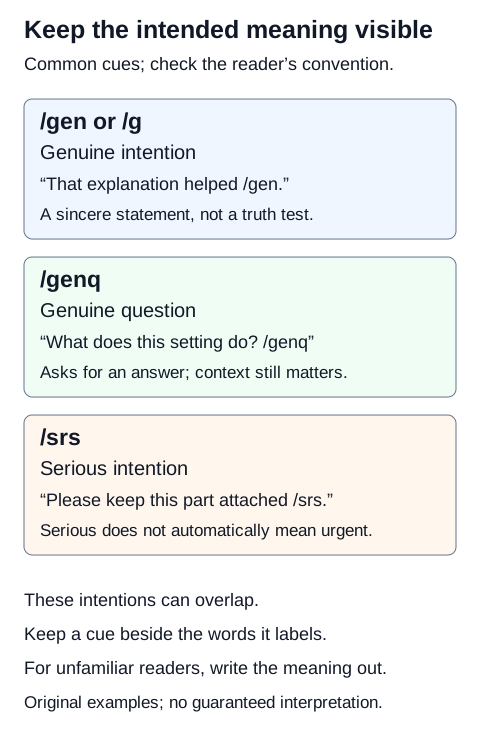
These are tone indicators, also called tone tags: short textual cues that label the writer’s intended tone. In the documented conventions used here, /gen means genuine, /genq means genuine question and /srs means serious. The shorter /g also appears for genuine.
| Tag | Common expansion | Useful scope | Not established by the tag |
|---|---|---|---|
| /gen; also /g | Genuine: the sender means the statement sincerely. | A statement or question whose genuine intention needs labeling. | The statement is accurate, welcome or free of every possible ambiguity. |
| /genq | Genuine question: the sender is asking for an answer. | A question that might otherwise look rhetorical, mocking or challenging. | The wording is automatically gentle, or the recipient owes an answer. |
| /srs | Serious: the sender means this seriously. | A serious statement, question or request. | The situation is urgent, the claim is verified or the reader must agree. |
A genuine question can also be serious. These are overlapping descriptions, not three exclusive boxes that every message must fit. Choose a cue only if it helps this reader understand your intended message; you do not need to attach every applicable label.
“Gen” in an unrelated sentence is not automatically a tone tag. Look for the slash, the message and the writer’s use before applying this explanation. If you cannot identify the intended meaning, ask what that particular abbreviation means.
Use the glossary as a convention, not a universal code
The linked tone-indicator overview lists genuine, genuine question and serious among documented slash-tag meanings. Felicia Jennings-Brown’s 2022 student newspaper article illustrates /g for genuine and /srs for serious in contemporary online communication. These sources establish examples of public usage; they are not a mandatory platform specification or a survey showing how every group interprets the tags.
Keep that distinction visible. A friend may prefer /gen, another may use /g, and an unfamiliar reader may recognize neither. Ask what someone means if their usage conflicts with the glossary or matters to your response. Do not assume a communication preference from someone’s age, diagnosis or membership of a community.
The student article includes broader historical and social claims. This guide uses its literal tag examples, without adopting a claim about a tag’s exact inventor, universal consistency or clinical benefit. The dialogues below are newly written teaching examples, not evidence collected from real messages.
Format a cue beside the words it labels
The forms in this guide begin with a forward slash: /gen, /genq and /srs. A readable example puts a space before the tag at the end of the relevant sentence: What does this setting change? /genq. Keep the question itself, including any needed context, in the ordinary wording.
This is an example format, not a grammar rule binding every chat. Follow a shared convention when you know it; otherwise, write out “I’m genuinely asking” or “I mean this seriously.” Capitalization or punctuation alone is not reliable evidence of a person’s intention.
For a mixed message, separate the parts. The shelves have declared independence /j. Could I borrow your level? /genq places one label beside the joke and another beside the real question. A single tag after the entire paragraph may leave the reader unsure which words it covers.
Quotation scope matters too. In They wrote “Great idea /s.” I’m asking which idea they meant /genq., the sarcasm cue belongs to the quoted words, while the genuine-question cue belongs to the narrator. If the formatting becomes hard to follow, describe that distinction in words instead of stacking more symbols.
Compare eight contexts and written-out alternatives
Each invented example names an intended reading and what still needs clarification. The alternatives are suggestions to adapt, not scripts that guarantee agreement or a particular emotional response.
| Context | Tagged message | Intention labeled | Written-out alternative and remaining detail |
|---|---|---|---|
| Rules at a game night | “Can a player pass twice in a row? /genq” | The sender wants to understand the rule, rather than making an obvious rhetorical point. | “I’m learning the rules: is a second consecutive pass allowed?” The reply still needs the ruleset or game being discussed. |
| An unusual recipe step | “Why is the pan cooled before adding this? /genq” | The writer labels the question as genuine curiosity. The tag does not make a food-safety claim. | “I’m trying to follow this recipe. What does cooling the pan achieve at this step?” Name the actual recipe and ingredient if those determine the answer. |
| A sincere compliment | “Your explanation helped me understand the diagram /gen.” | The writer intends the compliment sincerely; this is a statement, not a request for information. | “Thank you for explaining the arrows. I understand where the load goes now.” Use the factual detail only when it describes your experience. |
| A serious request during play | “Please leave the camera on the table /srs.” | The request is meant seriously, even if the surrounding chat is playful. | “Please leave the camera on the table while I finish setting it up.” Supply the practical reason or duration when it helps the reader act. |
| A low-stakes but real preference | “I do want to keep the longer book title /srs.” | The preference is serious. Seriousness alone does not imply an emergency or a stronger right to decide. | “I prefer the longer title because it names the place. Could we compare it with the short version?” The group can still discuss or disagree. |
| A sentence that sounds like a challenge | “Did you read the instructions? /genq” | The tag declares a genuine question, but the bare words may still sound accusatory. | “Have you had a chance to read the setup steps? I can explain the part about the cable.” Keep that offer only if it is what you intend. |
| A question following a joke | “My shelves have declared independence /j. Do you have a level I could borrow? /genq” | The joke and the genuine borrowing question have separate scopes. Neither tag identifies when the level is needed. | “I’m joking about the shelves. Could I borrow your level for an hour this afternoon?” A recipient can decline the request without disputing the tags. |
| An unfamiliar reader | “Do you want the window open? /genq” Recipient: “What is genq?” | The unfamiliar abbreviation has become an extra piece of information to explain. | “It means genuine question. I’m asking whether you would prefer the window open.” Explain once; use ordinary wording when that serves this reader better. |
Read the last column as carefully as the tag. A genuine question can still omit the object being discussed; a serious request can still omit its time. Supply those details when they determine what the reader should do.
A genuine question can still need gentler wording
/genq is useful when a question could be mistaken for a rhetorical challenge, but the cue does not rewrite the question. “Did you even read it? /genq” may still sound dismissive because of “even.” If you are checking whether someone has the instructions, ask that directly and remove the unnecessary challenge.
Similarly, “Why would you want that? /genq” can leave the reader unsure whether you want information or are criticizing a preference. “I’m trying to understand what you like about that option” gives the question a clearer purpose, when that is your actual purpose.
Genuine curiosity does not require someone to reveal personal details or continue a topic they have declined. Ask once, accept the answer or refusal, and respond to the actual boundary. If you need information to complete a shared task, identify that specific need rather than using the tag to demand a broader explanation.
A recipient can say the message sounded harsh even when you intended it sincerely. Clarify the intended question and address the wording that caused concern. Recognizing your intention and recognizing its effect are different parts of the exchange.
Keep seriousness, sincerity and evidence separate
/srs says the sender intends seriousness. It does not provide a deadline, prove a fact or give one preference priority over another. “I want the longer title /srs” can be a real preference about a low-stakes design choice. Ask about the reason or decision criteria instead of interpreting seriousness as an emergency.
/gen also does not verify a claim. A person can sincerely believe something that is mistaken. When the message makes a factual assertion, use appropriate evidence to check it; when it states a preference, understand the preference; when it requests an action, identify the action and practical details.
If urgency matters, state it directly: “Please return the key before we leave at four.” If you are making a real request during a playful conversation, write “I do need the key back” rather than relying on the tone label alone. Use a tag as optional support for a clear sentence.
Do not translate the absence of /srs into proof that a message is a joke. Many serious messages have no tone tag. The same applies to sincerity: an untagged compliment is not automatically ironic or false.
Correct the misunderstanding that changes the reply
| Misuse | Problematic reading | Useful correction |
|---|---|---|
| Treating /srs as evidence | “It must be true because they added /srs.” | Read it as an intention label. Check the factual claim through an appropriate source. |
| Making a tag do the whole request | “That thing /genq” with no identifiable question | Name what you are asking and the relevant context. A tag cannot reconstruct an absent question. |
| Demanding an answer | “I used /genq, so you have to explain.” | Ask clearly and allow a refusal. Genuine curiosity is not an entitlement to personal information. |
| Covering mixed sentences with one label | A joke, a quotation and a real request followed by one /srs | Put a cue beside the intended part or write the parts separately in ordinary words. |
| Escalating with more labels | Repeating /gen /genq /srs after someone says the wording hurt | Acknowledge the actual concern and clarify or change the wording. More labels do not settle its effect. |
When someone does not recognize the abbreviation, a short explanation is enough: “It means genuine question; I’m asking whether you prefer the window open.” The explanation should return them to the actual question, rather than introduce a long glossary they did not need.
When the wording and cue disagree, revise the wording. When the missing detail is factual, provide that detail. When the concern is how a message landed, acknowledge it. Those are different repairs; adding a different tag cannot do all of them.
Practice six intention and scope decisions
Try these original questions before expanding their explanations. Identify the literal statement or question, then decide what the label adds and what remains unknown.
Case 1
A friend writes “That is a thoughtful present /gen.” Must you interpret this as a request to explain where you bought it?
Show answer and explanation for case 1
No. It labels a sincere statement, rather than supplying a question.
The literal sentence is a compliment. The common genuine label explains its intended sincerity for a reader who knows the convention. It does not add an unstated shopping question or require a detailed reply. You can acknowledge the compliment normally. If the next sentence asks about the shop, answer that separate question if you want to; do not treat the tag as though it contained it.
Case 2
Someone asks “What does this setting change? /genq” in a technical chat. Does the tag identify the device, setting or version?
Show answer and explanation for case 2
No. Those details must come from the words and context.
The question is presented as genuine, but the recipient may still lack enough information to answer. Ask which setting, device or version is being discussed. A useful rewrite names the item: “I’m trying to understand the exposure-lock setting on this camera. What does it keep fixed?” Use details that are actually known. Recognizing the intention label is one step; identifying the referent is another.
Case 3
A classmate writes “I mean this seriously /srs” about their preferred poster layout. Is this proof that the choice is urgent or objectively correct?
Show answer and explanation for case 3
No. A serious preference can be low-stakes and open to disagreement.
Seriousness describes how the person intends the statement. Urgency would need a time constraint, and correctness would need evidence or agreed criteria. You can take the preference seriously while asking why that layout helps readers or comparing it with another design. Avoid translating the tag into an emergency or a command. If there is a real deadline, it should be stated separately in the actual request.
Case 4
You quote “Why would anyone do that? /s” and then ask “What does that reply refer to? /genq.” Does the sarcasm label make your own question sarcastic?
Show answer and explanation for case 4
No. Keep each cue with the words it labels.
The /s is inside the quotation; your /genq follows your own question. You are reporting a sarcastic line and asking a genuine question about its referent. Preserve that distinction when copying the exchange. A cropped excerpt may lose the scope, so a written-out version can help: “The quoted reply is marked sarcastic. I’m asking which action it refers to.” You still need context to identify that action.
Case 5
A recipient says “That question sounded like an insult” after you added /genq. Is repeating the tag enough to resolve the exchange?
Show answer and explanation for case 5
No. Explain the intended question and address the wording that caused concern.
You can mean a question genuinely and still phrase it in a way the reader finds hurtful. Ask what sounded insulting if that is useful, acknowledge the concern, and restate the information you actually need without the unnecessary challenge. “I was asking whether the setup steps were available; I can see my wording sounded accusatory” is useful only when it reflects the situation. A label is not a ruling on the other person’s experience.
Case 6
A new group member does not recognize any slash tags. Should essential directions be understandable only through /gen or /srs?
Show answer and explanation for case 6
No. Write the important meaning or instruction in ordinary words.
Explain a tag briefly if the person asks, then provide the actual statement, question or request. You can ask about their communication preference when it matters, without assuming it from their age, diagnosis or group membership. For an essential instruction, name the action, item and time independently of the cue. The same message should still be useful if the reader skips an unfamiliar abbreviation. Familiar labels can support the wording, but they should not hide it.
Use the reference card and correction worksheet
Download the gen, genq and srs reference card and the dialogue and correction worksheet. The worksheet contains the comparison, all eight invented contexts, five misuse corrections, six explained exercises and a blank message review.
- Write the literal statement, question or request.
- Locate the exact tag and the words it labels.
- Record the intended reading without treating it as proof of truth, urgency or someone else’s feelings.
- Name the missing detail or concern that changes your response.
- Draft a plain-language clarification and revise it after the answer.
Use invented or anonymized messages when practicing with others. The worksheet does not require submitting a private chat or identifying a sender to this site. For the wider comparison with visual cues, read tone indicators versus emojis. For missing literal wording, use the acronym clarification replies. A tag is most useful when the message itself remains understandable.
Sources and further reading
- Tone indicator: documented slash-tag conventionsPublic overview listing genuine (gen/g), genuine question (genq), serious (srs), joking (j) and sarcasm (s), with sentence-end examples. Full captured text read. Usage conventions, not a universal grammar or clinical evidence.
- Felicia Jennings-Brown: Tone Indicators — The Science Survey, 16 March 2022A contemporary student newspaper explanation with literal /g and /srs examples. Full captured article text read; broader origin, uniformity, social statistics and clinical implications are not adopted.