Practical guide
Does a Period at the End of a Text Mean Someone Is Angry?
No—a period at the end of a text does not by itself establish that someone is angry. It can affect how a short reply is perceived, but the actual words, the person’s usual writing style and the conversation matter. Use these original context comparisons and clarification replies to decide what information you need instead of assigning a mood to one punctuation mark.
Read the message before assigning a mood to the mark
A final period can simply end a sentence. In a very short reply, it can also feel unusually deliberate to a reader who expects unpunctuated chat. That difference in how a message lands is worth understanding; it is not a direct measurement of the sender’s emotion.
Start with the literal answer or request. “Yes.” still supplies an affirmative answer. “Please send the revised version.” gives an instruction. “I don’t want to discuss this tonight.” states a pause. The mark can influence your impression, but it does not replace those words.
Then compare the sender’s usual style, if you actually know it. A person who routinely writes full sentences is different from a close friend whose style has noticeably changed. For a new contact, admit that you have little baseline information. Do not infer a universal habit from their age, job or membership of a group.
Finally, ask whether anything needs clarification. You can accept a clear answer without investigating every dot. If a plan, task or known disagreement is unresolved, ask about that issue directly. A useful question should help you act on the reply, not require the other person to defend their punctuation.
What the research actually found
In Texting insincerely: The role of the period in text messaging, Gunraj and colleagues asked whether a sentence-final period could serve as a social cue. The institutional abstract reports that short text responses ending with a period were rated as less sincere than equivalent responses without one. It reports no such difference for handwritten notes.
The Binghamton University news release describes 126 undergraduate participants and 16 experimental exchanges. The sender offered an invitation; the response was an affirmative word such as Okay, Sure, Yeah or Yup, either with a final period or without punctuation. Participants evaluated those exchanges.
| Feature | What was reported | What it does not establish |
|---|---|---|
| Participants | The university release reports 126 Binghamton undergraduates. | A rule shared by all ages, languages, communities or platforms. |
| Messages | Sixteen experimental invitation exchanges with affirmative one-word replies, with or without a final period. | The same effect for every long paragraph, task instruction, rejection or automated notice. |
| Outcome | Period-ended text replies received lower sincerity ratings; the abstract reports no such difference for handwritten notes. | Actual sender anger, a diagnosis of a relationship or a certainty about one real message. |
| Source scope | The institutional abstract, bibliographic record and university news release are used here. | A new replication, a reviewed full-paper effect size or a percentage chance that someone is angry. |
The important distinction is between how readers rated a message and what a real sender is feeling. “Less sincere” does not mean “angry,” “lying,” “ending a friendship” or “always rude.” The study gives a reason to pay attention to punctuation as one possible social cue; it does not give a mood detector.
The university release is dated December 2015 and reports an online publication in November 2015; the institutional record lists the journal issue as February 2016. This guide uses the abstract and release, rather than claiming a review of the complete nine-page paper. It supplies no effect-size calculation or percentage chance that a particular sender is upset.
Apply that scope when reading a headline. A result involving brief affirmative invitation replies should not automatically be extended to a long paragraph, a work correction, a message in another language or an automated notification. Your own conversation may differ in several of those ways.
Compare eight contexts and useful replies
These are original fictional exchanges. They are examples of how to reason about the wording and ask a practical question, not results from the experiment. The proposed replies do not guarantee a particular response. Use them only when they fit what you mean and what information you need.
| Context | Original message exchange | What the wording supports | Possible reply |
|---|---|---|---|
| A friend who normally punctuates replies | You: “Meet outside at six?” Friend: “Okay.” | The reply accepts the proposed plan. A period fits their stated usual writing habit; their private emotion remains unknown. | “Great, outside at six.” Clarify only if the plan itself is uncertain. |
| A friend after a changed plan | You: “Could we move it to seven?” Friend: “Okay.” | The words accept the change, but if their usual reply style differs, you may want to check whether the time is workable. | “Does seven still work for you, or would another time be easier?” |
| A family member using complete sentences | You: “When will you arrive?” Family: “I’ll be there at six.” | This is a complete answer to a time question. The final period can simply be ordinary sentence punctuation. | “Thanks, I’ll be ready at six.” Do not assign anger from sentence punctuation alone. |
| A colleague approving a defined item | You: “Can I send the revised agenda?” Colleague: “Approved.” | The reply communicates approval of the item just named. It does not tell you the colleague’s emotional state. | “Thanks, I’ll send the revised agenda.” Ask about the scope only if the item was unclear. |
| A manager giving a task correction | Manager: “Please use the revised file.” | The instruction is to use a different file. The words establish an action; a period does not establish the reason or intensity of any feeling. | “I’ll use the revised file. Is the shared-folder copy the current one?” |
| An unfamiliar contact | You: “Thanks for the introduction.” Contact: “You’re welcome.” | You have little information about this person’s texting style. Brevity and punctuation do not supply a reliable mood history. | A simple “Thanks again” may be enough. Do not request reassurance when no practical uncertainty needs resolving. |
| A conversation after a real disagreement | You: “Shall we keep the original plan?” Other person: “Fine.” | The known disagreement gives you a reason to check the plan. The word and period still do not prove that the other person is angry or fully satisfied. | “Would you prefer the original plan, or should we choose a different option?” |
| A person stating a clear pause | Other person: “I don’t want to discuss this tonight.” | The pause is explicit in the words. It does not depend on whether the message ends with a period, no mark or an emoji. | “Understood. I’ll leave it for tonight.” Respect the stated pause rather than demanding an immediate explanation. |
The same question—“What does the period mean?”—can hide several different needs: confirming a time, identifying an approved item, understanding a correction or checking whether a plan is acceptable. Name the need first. Where the words already give a clear answer, an ordinary acknowledgement can be enough.
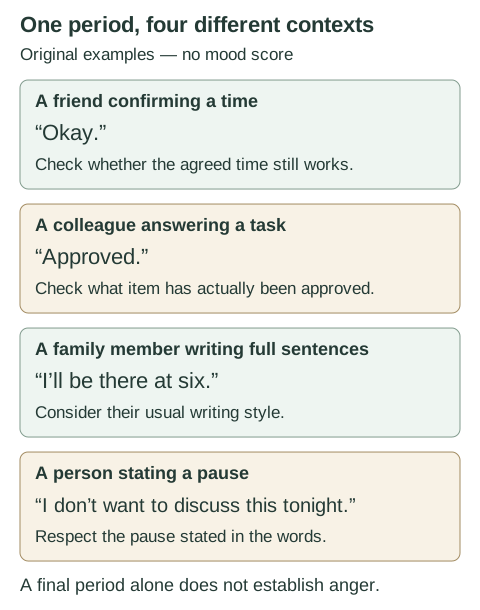
Ask about the part that changes your next step
If you are uncertain about a plan, ask about the plan: “Does seven still work, or would another time be easier?” If a work reply is unclear, ask about its scope: “Do you mean the draft is approved, or the budget as well?” These questions let the person clarify something concrete.
If there was a real disagreement, acknowledge the issue without presenting your interpretation as a fact: “I’m not sure the original plan works for both of us. Would you prefer another option?” That can be more useful than “Why are you angry?” when anger has not been stated.
You can mention your impression when it matters: “I read that as a brief answer and wasn’t sure whether the time still suited you.” Keep “I read it as” distinct from “You meant.” The first describes your experience; the second claims access to the other person’s intention.
Ask once, give room for an answer and respond to what the person says. If they explain that it was a normal acknowledgement, you have more information than the punctuation supplied. If they identify a concern, discuss that concern. If they explicitly ask for a pause, respect it instead of treating the request as another code to decipher.
You do not need to force a conversation about tone after every routine message. For a clear delivery notice or a simple confirmed time, the useful next step may already be obvious. Save clarification for ambiguity that changes understanding or action.
Make your own short reply easier to understand
When you intend a warm acceptance, add the actual meaning rather than relying on punctuation to carry it: “Yes, seven works—looking forward to it.” When you intend a neutral work acknowledgement, “Received; I’ll use the revised file” identifies both receipt and action. Use enthusiasm only when it reflects your intention.
If you disagree, state the disagreement: “Seven is too late for me. Could we keep six?” Removing a period would not make an unsuitable time suitable. If you are frustrated, explain the relevant issue in words rather than sending a deliberately ambiguous “Fine.” and expecting the other person to reconstruct it.
If someone says your reply sounded cold, a small clarification may help: “I meant yes to the plan; I wasn’t upset about moving the time,” when that is true. You can also acknowledge their impression without claiming they must have read it incorrectly.
For recurring misunderstandings with the same person, discuss a preference: “Would a slightly fuller reply help when I’m confirming plans?” Treat the answer as an agreement between those people. It does not create a rule that every period is rude or that every message needs an emoji.
The separate tone indicators versus emojis guide compares explicit labels and visual cues. They can support communication, but neither supplies missing task details or establishes a sender’s emotion by itself. Use a cue your reader understands and keep essential information in the sentence.
Keep different message signals separate
A final period, an ellipsis, a word written in capitals and a reaction icon are different features. Avoid transferring a rule about one to all the others. A decimal point in a version number or a period inside quoted material also needs to be read in its actual place, not automatically treated as the narrator’s mood.
The slang spelling periodt is a separate entry from the punctuation mark at the end of “Okay.” If you are asking about a word someone wrote, identify that word before applying advice about terminal punctuation.
Similarly, dry texting concerns a pattern of brief replies rather than a guaranteed meaning of one dot. Look at what the person contributes to the exchange and whether the actual conversation meets your needs. A single short reply cannot establish the whole pattern.
For an unfamiliar abbreviation, use the acronym clarification replies to ask for its expansion. Understanding the literal wording and understanding its tone are separate steps; guessing the second cannot fix a missing first.
Practice six message readings
Try these questions before opening the explanations. Focus on the information that the message supplies and what remains uncertain.
Case 1
An unfamiliar person replies “Sure.” to an invitation. Does the period prove they are annoyed?
Show answer and explanation for case 1
No. The invitation was accepted; their actual mood is still unknown.
A one-word reply with a period resembles the sort of short response studied in the cited research, but a lower group sincerity rating is not a finding about this person’s emotion. You also have no established baseline for their punctuation habits. Confirm the practical details if needed. If the invitation and time are clear, a normal acknowledgement may be more useful than asking them to reassure you about a mark.
Case 2
A colleague replies “Done.” after a thread mentioning both a draft and a budget check. What needs clarification first?
Show answer and explanation for case 2
Which task is complete, rather than what the period means.
The useful uncertainty is the scope of “Done.” Ask a question such as “Is the budget check complete as well, or just the draft?” That supplies information needed for the next step. Removing the period would not identify the completed item. A brief work reply can be entirely functional, so do not replace a task question with an accusation that the sender sounds angry.
Case 3
A report says period-ended replies were rated less sincere. Can you translate that into “Most people who use periods are angry”?
Show answer and explanation for case 3
No. That changes both the outcome and the population.
The sources describe perceived sincerity ratings for particular messages, not measured anger in their senders. The university release reports an undergraduate sample and brief affirmative replies to invitations. “Most people” would require a different population claim, and “are angry” would require different evidence. Keep the reported observation separate from any personal interpretation, and do not invent a percentage or universal rule.
Case 4
Someone writes “I need a break from this conversation.” Should adding an emoji change whether you respect the request?
Show answer and explanation for case 4
No. The request for a break is explicit in the words.
Read and respect the actual statement rather than searching the punctuation for permission to continue. The person may have several reasons for asking; the message does not require you to diagnose them. A short acknowledgement can confirm you understood the pause. If there is a separate urgent practical matter, name that matter specifically and handle it appropriately instead of treating a tone cue as evidence that the stated boundary was only a joke.
Case 5
A friend usually sends unpunctuated replies but has used periods in the last few messages. Is the change proof of anger?
Show answer and explanation for case 5
No. A changed pattern can be a reason for a focused check, but not proof.
A change in writing style is more informative than an isolated mark, yet you still do not know its cause. The friend may be writing more formally, responding briefly or dealing with a different situation. If the change affects a plan or a known disagreement, ask about that concrete issue once. Repeatedly checking every punctuation mark can create more uncertainty without adding useful information. Listen to the answer rather than continuing to score the dots.
Case 6
You intend a neutral acknowledgement, but a friend says “Okay.” sounded cold. Must you remove every period from future messages?
Show answer and explanation for case 6
No. Clarify the actual message and discuss that person’s preference if it keeps happening.
You can write “I meant yes to the plan; I wasn’t upset about changing the time,” if that is true. If you are upset, state the relevant concern instead of adding false warmth. One conversation can help the two of you agree on clearer wording; it does not establish a punctuation rule for every colleague or family member. The useful repair is communicating your intention honestly, not replacing all periods with exclamation marks.
Use the context checklist for a difficult reply
- Read the literal statement. What was accepted, declined, requested or left unspecified?
- Locate the exact cue. Is the period ending the message, inside a quotation or part of another written form?
- Check the known baseline. What do you actually know about this person’s ordinary style? Keep an unfamiliar contact’s habits unknown.
- Remember the shared context. Is there a changed plan, a task awaiting approval or a disagreement that deserves attention?
- Choose a specific question only if needed. Ask about the time, item, preference or concern that changes your response.
- Use the clarification. Respond to what the person says and respect an explicit pause or boundary.
Download the original context comparisons and reply checklist. It includes the eight fictional exchanges and a brief sequence for choosing a question. It contains no anger probability or scoring system.
You can notice that a message felt abrupt without treating the feeling as proof of the sender’s intent. Keep the practical issue and the person’s actual explanation available to revise your first impression.
Sources and further reading
- Gunraj et al.: Texting insincerely — SUNY institutional abstract and publication recordReports sincerity ratings for short text exchanges with or without a final period, and the absence of that difference for handwritten notes. The complete journal paper was not reviewed for this guide.
- Binghamton University: Study—Text messages that end in a period seen as less sincereUniversity release dated 8 December 2015; reports the undergraduate sample and 16 experimental invitation exchanges with affirmative one-word replies. This is study context, not a diagnosis of a real sender.